Rapunzel Story
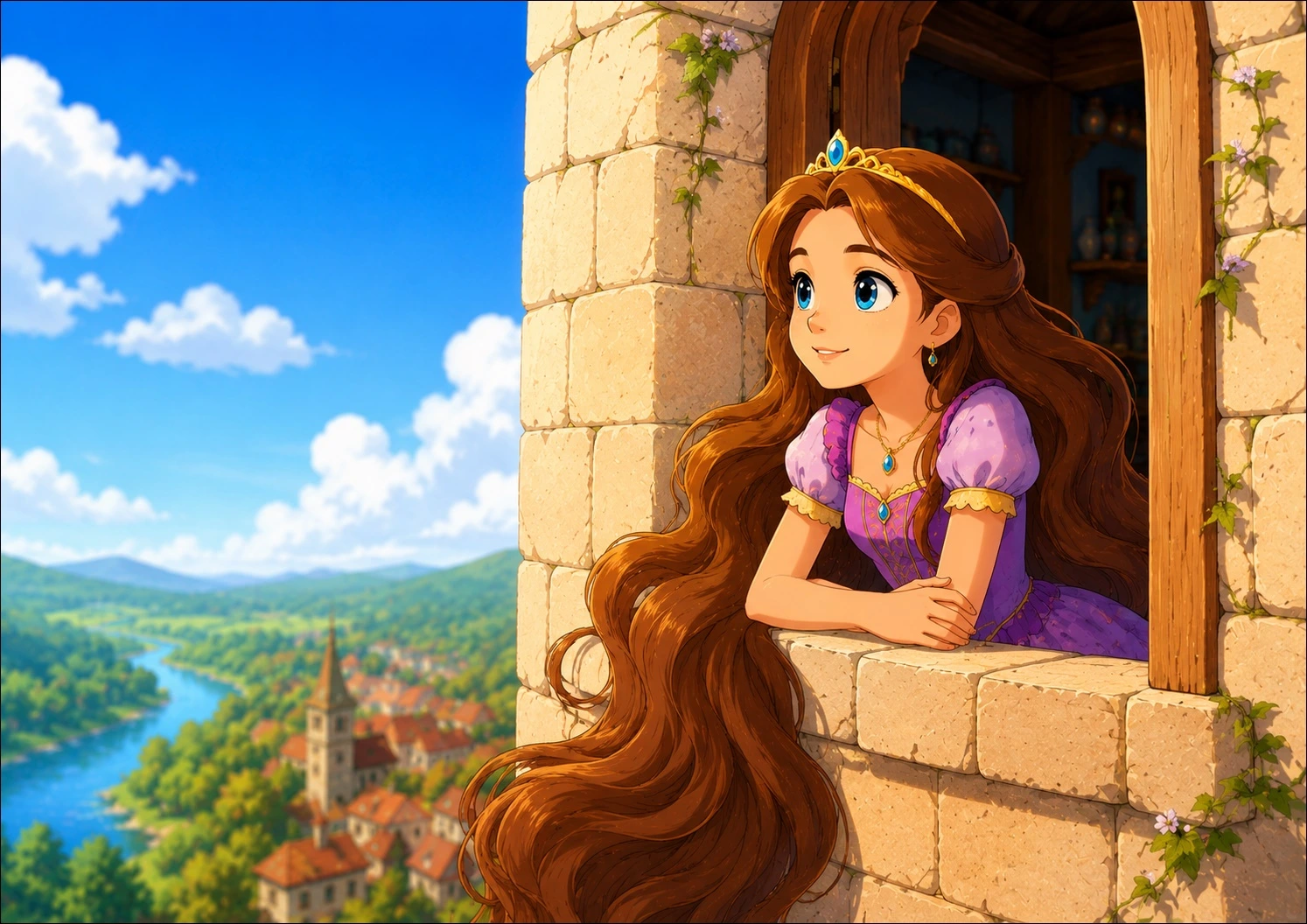
Once upon a time, in a kingdom of green hills, silver rivers, and quiet forests, there lived a baby girl with hair as soft as morning light.
Her parents, the king and queen, loved her more than any jewel in their palace. When she smiled, the queen said the whole room seemed warmer. When she slept, the king would stand beside her cradle and whisper promises about gardens, music, books, and all the good things waiting for her in the world.
But beyond the palace walls lived a lonely witch named Maralda.
Maralda had a garden hidden behind high stone walls. In that garden grew a rare plant called rapunzel, with leaves so fresh and green that people in the kingdom spoke of it in whispers. Long ago, before the princess was born, the queen had wished for that plant while she was weak and unwell. The king had taken some from Maralda’s garden, and the witch had never forgotten it.
On the night the baby princess was born, Maralda came to the palace wrapped in a cloak as dark as wet bark.
— "A promise was made," she said.
The king stepped in front of the cradle.
— "No promise can give you this child."
Maralda looked at the baby’s golden hair, already shining faintly in the candlelight.
— "Then you should have thought of that before stealing from my garden."
Before anyone could stop her, the witch lifted the child into her arms and vanished into the night.
The kingdom searched for days.
Then weeks.
Then years.
No horse found a trail. No hunter found a clue. The queen kept one small golden ribbon from the cradle and prayed that her daughter would one day return.
Maralda named the child Rapunzel, after the plant in her garden.
She did not raise her in a village.
She did not raise her in a cottage.
She raised her in a tall stone tower deep in the forest, where the trees grew thick and the paths twisted like secrets.
The tower had no door.
It had no stairs.
At the very top, there was only one round window where the wind could enter and the moon could look inside.
Whenever Maralda wanted to visit, she stood below the tower and called:
— "Rapunzel, Rapunzel, let down your hair."
Then Rapunzel would loosen her long golden braid and let it fall from the window. It dropped down the wall like a shining rope, and Maralda climbed it with careful hands.
As Rapunzel grew, her hair grew with her.
It became longer than a curtain.
Longer than a staircase.
Longer than the tallest tree beside the tower.
But Rapunzel’s world remained small.
She had a bed, a wooden table, a shelf of old books, a painted cup, and three forest friends who visited whenever the window was open: Whiskers the rabbit, Feather the bluebird, and Fluffy the squirrel.
Rapunzel loved them dearly.
She shared crumbs with Whiskers.
She sang to Feather.
She scolded Fluffy whenever he tried to hide acorns in her pillow.
— "That is not a pantry," she told him one morning.
Fluffy stared at her as if he strongly disagreed.
Rapunzel laughed, but sometimes the laughter faded quickly.
From her window, she could see the distant tops of palace towers and the smoke of village chimneys. She could hear bells on market days. Sometimes, when the wind blew from the east, she caught the smell of bread baking somewhere far away.
She often wondered what it would be like to walk on a road.
To choose a direction.
To hear people talking because they were beside her, not because their voices drifted faintly through the trees.
When she asked Maralda about the world, the witch always gave the same answer.
— "The world is cruel."
— "All of it?" Rapunzel asked.
— "Enough of it."
— "Then why do the birds fly back to it every morning?"
Maralda’s mouth tightened.
— "Birds are foolish."
Rapunzel looked at Feather, who sat proudly on the windowsill.
— "He does not look foolish."
— "He is small. That is different."
Rapunzel said nothing, but she remembered the answer.
Maralda was not always shouting. Sometimes she brought cloth, fruit, books, and combs. Sometimes she sat by the window and brushed Rapunzel’s hair in silence.
But love that locks a person away is not love.
Rapunzel did not know those words yet.
She only knew that her heart felt too large for the room.
So she sang.
Her songs filled the tower, floated over the treetops, and slipped between the branches. She sang of rivers she had never touched, roads she had never walked, and stars that seemed freer than anyone.
One spring morning, a prince from a neighboring kingdom rode through the forest on a white horse.
His name was Prince Adrian, and he had not come searching for treasure or battle. He had come because he had heard villagers speak of a voice hidden among the trees, a voice so clear and lonely that even the old woodcutters stopped their work to listen.
When he heard Rapunzel singing, he pulled the reins gently.
The horse stopped.
The forest seemed to hold still.
Adrian followed the song until he reached the tower.
He looked up and saw Rapunzel at the window, her golden hair catching the sunlight like a river of fire.
For a moment, he forgot every polite greeting he had ever learned.
Rapunzel saw him too.
She stepped back from the window, then slowly returned.
— "Who are you?" she called.
Adrian removed his hat.
— "My name is Adrian. I heard your song."
— "You followed a song through the forest?"
— "Yes."
— "That sounds unsafe."
He smiled.
— "It was worth the risk."
Rapunzel studied him carefully. He did not look like Maralda’s stories of dangerous strangers. He looked dusty, surprised, and kind.
— "There is no door," she said.
— "I noticed."
— "And no stairs."
— "I noticed that too."
— "Then you cannot come up."
Adrian looked around the base of the tower.
— "Not today."
Rapunzel almost smiled.
He returned the next day.
And the day after that.
He stood below the window and told her about the world beyond the forest: a bridge covered with red leaves in autumn, a bakery where the baker sang badly but loudly, a square where children chased pigeons, and a palace garden where the queen still tied a golden ribbon to the same tree every year.
Rapunzel listened closely.
— "Why does the queen tie a ribbon there?" she asked one afternoon.
Adrian’s voice softened.
— "She lost her daughter long ago. They say the princess had golden hair."
Rapunzel touched her braid.
Something inside her became very quiet.
— "Do they know what happened to her?"
— "No."
That night, after Maralda left, Rapunzel could not sleep.
She thought of the queen, the ribbon, the lost child, and the witch’s strange silence whenever Rapunzel asked about her parents.
The next day, Adrian came again.
This time, Rapunzel asked him to hide behind the trees and watch.
Near sunset, Maralda arrived and called:
— "Rapunzel, Rapunzel, let down your hair."
Rapunzel lowered her braid. Maralda climbed up, never noticing Adrian among the leaves.
After the witch left, Adrian stepped from the trees, pale with anger and concern.
— "She climbs your hair?"
— "It is the only way in."
— "Then we will make another way out."
From then on, Adrian brought a piece of silk each time he visited. Blue silk, green silk, gold silk, and white silk. Rapunzel hid them beneath her bed and worked at night by moonlight, knotting them together into a long, soft ladder.
It was slow work.
Her fingers grew sore.
Some knots came loose and had to be tied again.
But every knot felt like a promise.
— "When the ladder is finished," Adrian said one day, "you can come down by your own hands."
Rapunzel looked at the forest below.
— "What if I am afraid?"
— "Then be afraid and climb anyway. I will wait at the bottom."
Rapunzel held those words close.
But secrets are fragile things.
One evening, Maralda climbed into the tower, breathing hard after the long ascent.
Rapunzel, distracted by thoughts of the silk ladder, spoke without thinking.
— "Why are you so much heavier to pull up than Prince Adrian?"
The tower went silent.
Maralda’s eyes sharpened.
— "Prince Adrian?"
Rapunzel’s face went cold.
She knew at once what she had done.
Maralda crossed the room and lifted the hidden silk from beneath the bed. The ladder spilled across the floor in a bright heap.
— "After everything I did to keep you safe," the witch whispered, "you planned to leave me."
Rapunzel stood straight, though her hands trembled.
— "You kept me locked away."
— "Because the world takes what I love."
— "Then you should have learned to love without holding so tightly."
Maralda’s face twisted with grief and fury.
She took silver scissors from her cloak.
Rapunzel stepped back.
— "No."
But Maralda caught the golden braid and cut it with one sharp stroke.
The hair fell to the floor.
Rapunzel felt lighter, colder, and strangely awake.
Before sunrise, Maralda carried her far from the tower to a wild place beyond the northern hills. There were thorn bushes, stone paths, and a small abandoned hut with a roof full of holes.
— "Here," Maralda said. "Learn what the world is."
Then she left Rapunzel alone.
Rapunzel cried that day.
She cried for her lost hair, for Adrian, for the parents she might have had, and for the years that had been taken from her.
But when evening came, Feather found her.
The little bluebird landed on the broken windowsill of the hut and chirped.
Rapunzel wiped her cheeks.
— "You came all this way?"
Feather chirped again.
— "Then I suppose I am not entirely alone."
She learned to live there.
She found berries that were sweet and berries that were not worth trying twice. She patched the roof with branches. She carried water from a stream. She sang when fear came close, because singing was the one thing no one had managed to take from her.
Back at the tower, Adrian arrived at dusk.
He stood below and called softly:
— "Rapunzel?"
From above came Maralda’s voice, strangely sweet.
— "Rapunzel, Rapunzel, let down your hair."
The golden braid dropped from the window.
Adrian climbed quickly, hope beating in his chest.
But when he reached the room, he found not Rapunzel, but Maralda holding the severed braid.
— "She is gone," the witch said.
Adrian stepped backward in shock.
— "What have you done?"
Maralda lifted her hand. The room filled with a cold wind. Adrian lost his footing and fell from the window.
He landed in a tangle of thorn bushes below.
The thorns tore his cloak, scratched his face, and wounded his eyes. When he crawled free, the world had vanished into darkness.
Adrian could no longer see.
For many months, he wandered through valleys and forests, guided by a staff and by the memory of Rapunzel’s voice. He called her name in villages, near rivers, beside fields, and under ruined bridges.
No one knew where she was.
Years seemed to pass inside his heart.
Still, he did not stop searching.
One evening, when the air smelled of rain and wild roses, Adrian reached the northern hills. He was tired, hungry, and nearly ready to sit down beside the road until morning.
Then he heard a song.
It was faint.
It was older than the voice he remembered, softer around the edges, but it was hers.
Rapunzel’s song.
Adrian stood very still.
— "Rapunzel," he whispered.
He followed the sound step by step, through the grass, past the stones, toward the little hut with the patched roof.
Rapunzel was standing outside, singing while she gathered water from a wooden pail.
She turned when she heard him stumble.
For one breath, she could not move.
Then the pail dropped from her hands.
— "Adrian?"
He lifted his face toward her voice.
— "I found you."
Rapunzel ran to him. When she saw the scars near his eyes and the way he reached for her without seeing, grief broke open inside her.
— "What happened?"
— "I climbed the tower," he said. "You were gone."
Rapunzel held his face in her hands and wept.
Her tears fell over his wounded eyes.
Warmth spread where they touched.
Adrian gasped.
Light returned slowly, first as silver, then as gold, then as the shape of Rapunzel’s face before him.
— "I can see," he whispered.
Rapunzel laughed through her tears.
— "Then look carefully. My hair is shorter."
Adrian smiled, his eyes shining.
— "You are still Rapunzel."
For a long while, they stayed there in the rain-scented dusk, holding each other as if the years between them were finally letting go.
At last, Adrian told her what he had learned about the lost princess, the queen’s golden ribbon, and the kingdom that had never stopped hoping.
Rapunzel touched the small scar in her heart where the truth had always waited.
— "Then I have a home to find."
— "Yes," Adrian said. "But only if you choose it."
Rapunzel looked at the hut, the hills, the forest, and the road beyond them.
For the first time in her life, no tower held her.
No witch spoke for her.
No window decided how much of the world she could see.
— "I choose it," she said.
Together, they traveled to the palace.
The queen was in the garden when Rapunzel arrived. She was tying a golden ribbon to the same tree, just as she had done every year.
When she saw Rapunzel, the ribbon slipped from her fingers.
The king came running.
No one needed proof at first. The queen knew her daughter by her eyes. The king knew her by the small crescent birthmark near her wrist. Rapunzel knew them by the way her heart seemed to remember what her mind had forgotten.
The palace bells rang until birds rose from every roof.
People filled the streets with flowers.
Adrian stood beside Rapunzel, not as the person who had saved her, but as the friend who had helped her believe she could step into her own life.
As for Maralda, she was never allowed near Rapunzel again. Some said she wandered back to her walled garden and lived there with only the wind for company. Others said she finally opened the gate and let the wild plants grow where they wished.
Rapunzel did not spend her days hating her.
She had too much living to do.
She walked through markets.
She read maps.
She learned the names of roads.
She sang in the palace garden, not because she was lonely, but because joy also needs a voice.
And when children asked about the tower, Rapunzel told them the truth.
— "I was afraid," she said. "I was lonely. I made mistakes. But I kept singing, and one day my song found the road back to me."
Her golden hair grew again, though she never used it as a ladder after that. She braided it with the queen’s ribbon and wore it over her shoulder, not as a chain, not as a rope, but as part of her story.
Years later, people still told the Rapunzel story across the kingdom.
They told of the tower with no door.
They told of the witch’s call.
They told of the prince, the silk ladder, the thorns, the lost years, and the tears that brought sight back.
But most of all, they told of Rapunzel herself.
The girl who grew up behind stone walls.
The girl who kept kindness alive in a lonely room.
The girl who learned that freedom was not only being rescued.
It was choosing, step by step, to live beyond fear.
And every night, when the kingdom grew quiet and the first stars appeared, the queen would look toward the forest and smile.
Because the lost child had come home.
Because the tower was empty.
And because Rapunzel’s song no longer sounded like longing.
It sounded like peace.