The Dwarves and the Elves
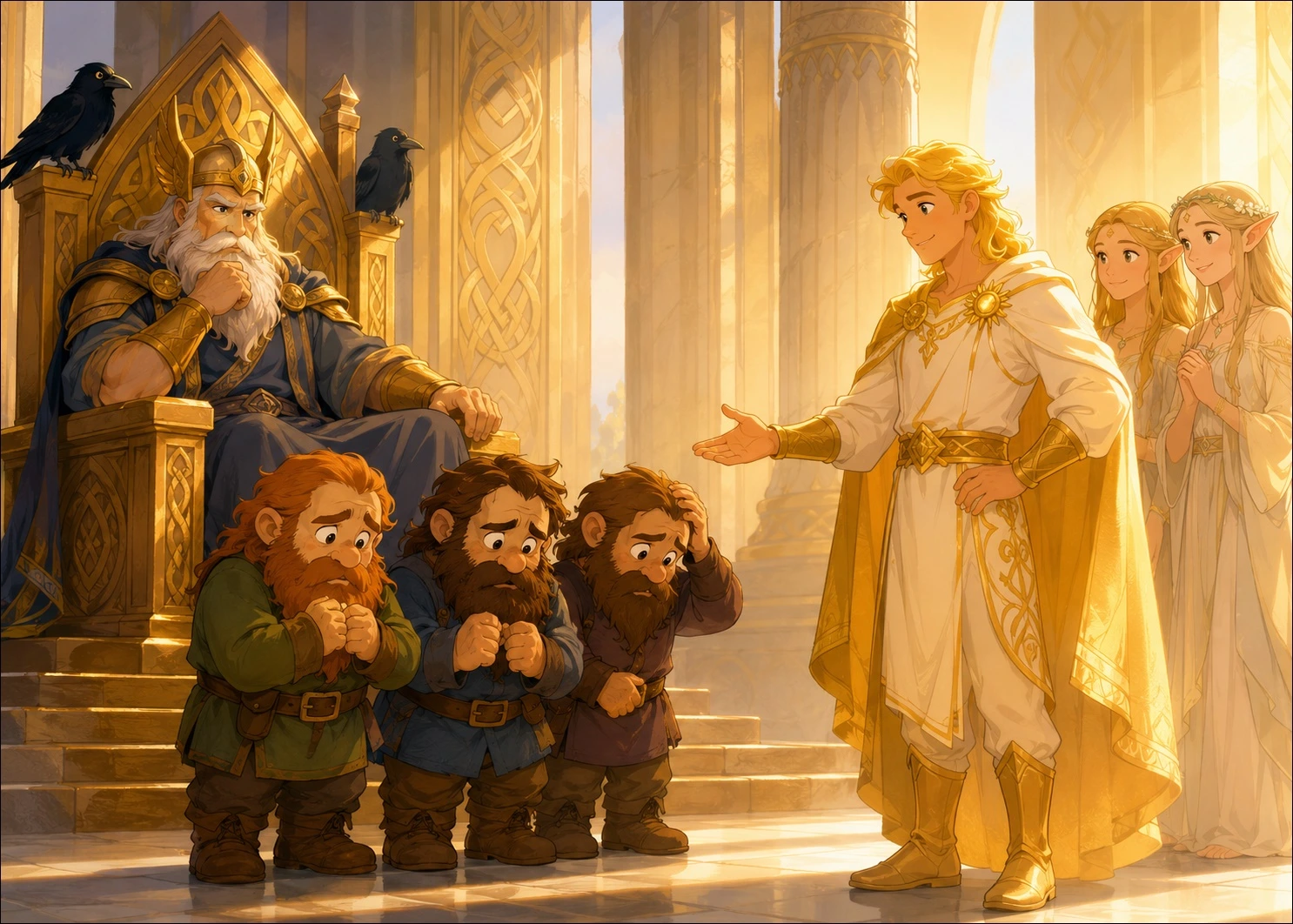
The Dwarves and the Elves by A. and E. Keary is a Norse mythology tale about Odin’s judgment, the restless Dwarves, the gentle Light Elves, and the order that must be restored between mischief and purpose. From Asgard, Odin looks down upon the earth and sees that humankind is troubled not only by giants, but also by hidden creatures whose clever hands bring confusion, fear, and harm.
When the Dwarves and Light Elves are summoned to the Hall of Justice in Gladsheim, Odin separates cruelty from idleness. The Dwarves must answer for spoiled harvests and the dark secret of Kvasir’s blood, while the Light Elves face a quieter fault: they have lived without doing harm, but also without doing good. Their future changes when Frey, the bright god of sunshine, flowers, bees, fruit, and harvest, is chosen to guide them in Alfheim.
Read The Dwarves and the Elves Online
High above the human world, beyond the clouds and the cold northern winds, Odin sat in Asgard and watched the earth below. From his great seat, no valley was too hidden, no sea too distant, and no village too small for his sight. He saw forests moving under the wind, rivers shining between fields, mountains standing in silence, and homes where people hoped to live safely through each season.
The world was beautiful. Odin knew that. The dark northern shore had its own stern greatness. The green hills softened beneath the sun. The fields waited for seed, rain, and harvest. Yet beauty alone could not protect the earth. Men were often afraid, and fear made them slow to act. They saw danger, but they did not always know how to face it.
As Odin looked toward a stormy coast, he saw a giant from Jötunheim crossing the land. The creature had three terrible heads, and each head seemed crueler than the last. A shepherd boy stood near the sea with his flock, unaware that the giant had come down from the wild rocks.
Before the boy could escape, the giant seized him and threw him into the waves. Then he gathered the sheep into a heavy sack as easily as a child might gather fallen leaves. Men nearby saw the deed, but terror held them still.
Odin’s face grew dark.
“The earth is fair,” he said, “but its people are too easily frightened.”
Thor heard those words and rose at once. Anger flashed in him like lightning behind a thundercloud.
“Then I will go to Jötunheim,” Thor said. “I have made a belt of strength, a glove for my hand, and a hammer fit for battle. Giants should not walk among men without answer.”
Thor left the hall, and the sound of his steps rolled through Asgard like distant thunder.
Odin continued to watch the earth. Soon he saw trouble of another kind. This danger did not roar like a giant or shake the ground beneath its feet. It was smaller, quicker, and more secret.
In a quiet field, a farmer walked behind his plough and scattered wheat into the open furrows. He thought of bread, winter stores, and the mouths he hoped to feed. But behind him crept a Dwarf with sharp eyes and a crooked smile.
Every time the farmer dropped a grain, the Dwarf touched it and changed it into a little gray stone. The farmer covered the stones with earth, believing he had planted wheat. The Dwarf followed him row after row, delighted by the hidden ruin.
Odin frowned.
Then his gaze moved farther, to a lonely place beside dark water. There two Dwarves had trapped Kvasir, the wisest of men. Kvasir had walked through the world carrying understanding wherever confusion had settled. He answered hard questions, calmed disputes, and spoke with a wisdom that made many think he was almost divine.
The two Dwarves did not honor him. They forced his head beneath the water and held him there until his life was gone. Afterward, they mixed his blood with honey and hid the strange drink in stone jars, proud of the terrible secret they had made.
Odin had seen enough.
He called Hermod, his swift messenger, whose words could travel faster than birds and whose feet did not tire on any road.
“Go to the Dwarves and the Light Elves,” Odin said. “Tell them Odin summons them to Gladsheim. They are to stand before the Hall of Justice and answer for their place in the world.”
Hermod bowed and went at once.
The Dwarves received the summons with confusion. Some were frightened, wondering what Odin had seen. Others puffed themselves up, thinking the gods had called them because their cleverness deserved praise. They dressed in their finest little garments, though they muttered and argued all the way.
The Light Elves were surprised as well. They were gentle, bright creatures who loved flowers, warm air, soft wings, and playful hours beneath the sun. They had not done the cruel deeds of the Dwarves, but they had spent their lives drifting from blossom to blossom without helping anyone.
Hermod led them all toward Gladsheim. The Dwarves came in restless clusters, whispering, pushing, and looking sideways at one another. The Light Elves followed like pale sparks of morning light, trembling but curious.
When they reached the shining city of the gods, they found the Aesir gathered inside the Hall of Justice. Odin sat among them, stern and silent. The hall was wide, bright, and solemn. Even the boldest Dwarf lowered his voice at the doorway.
For a while, none of the little folk dared to come forward. The Dwarves crowded together and pretended not to be afraid. The Light Elves clung close, their faces bright with nervous tears.
Odin lifted his hand.
They moved a little closer.
He lifted his hand again.
The Dwarves shuffled forward, and the Light Elves followed.
Only after Odin beckoned a third time did they gather near his seat.
Then Odin spoke. His voice was calm, but every word carried through the hall.
“You have lived among humankind,” he said. “Some of you have used hidden skill to spoil honest labor. Some have frightened the helpless. Some have taken pleasure in confusion. Cleverness is not wisdom when the heart behind it is crooked.”
A few Dwarves laughed, but their laughter was thin and ugly. Many looked uneasy. The Light Elves began to weep softly, for they were tender creatures and could not bear the weight of Odin’s words.
Then Odin fixed his gaze on two Dwarves near the back.
“Step forward,” he said.
The two Dwarves came slowly.
“Tell this hall what you hid in the stone jars,” Odin commanded.
The Dwarves glanced at one another. One tried to smile.
“A drink,” he said.
“A rare drink,” added the other.
“Made with honey,” said the first.
“And with Kvasir’s blood,” said the second, as if this should impress the gods.
The hall became still.
Odin’s eyes did not move from them.
“And how did Kvasir die?” he asked.
The Dwarves shifted from foot to foot.
“We found him,” one said.
“Near the water,” said the other.
Odin rose.
“Do not bring lies into the Hall of Justice,” he said. “I saw what happened. You held him beneath the water. You killed wisdom and called it cleverness. You took a noble life and tried to turn it into treasure.”
The Dwarves had no answer. Their mouths closed, and their eyes dropped to the floor.
Odin gave his judgment.
“Those who chose cruelty shall no longer live freely in the open world. You shall go beneath the earth, far from sunlight, and tend the deep fires hidden below stone and root.”
The cruel Dwarves cried out, but Odin did not stop.
“Those who were mischievous rather than murderous shall also live underground. Since your hands are skillful, your skill shall be turned to labor. You shall dig in mines, shape metals, find gems, and work among gold, silver, iron, and diamond. Night may let you come out for a little while, but when dawn returns, you must vanish.”
With one motion of his hand, Odin dismissed them.
The Dwarves scattered in a rush of noise. Some complained. Some argued. Some fled without looking back. Down the steps of Gladsheim they went, across the shining city, over the fields, and into the secret openings of the earth. From that time on, the Dwarves belonged mostly to caves, mines, hidden fires, buried metals, and the work of the deep places.
The Light Elves remained.
They hovered near Odin’s seat, tearful and shining. They were not cruel like the Dwarves. They had not ruined fields or killed wise men. Yet Odin looked at them seriously, and they knew their own judgment was not finished.
“And you,” Odin said.
Before he could continue, the Light Elves began speaking all at once.
“We have not hurt anyone.”
“We only played among flowers.”
“We never meant harm.”
“We are not wicked.”
Odin waited until their small voices faded.
“Have you ever done good?” he asked.
The question puzzled them.
“Done good?” one repeated.
“Have you helped a seed grow?” Odin asked. “Have you opened a flower? Have you guided a bee to nectar? Have you guarded a nest? Have you strengthened a blade of wheat? Have you comforted any living thing?”
The Light Elves lowered their eyes.
“No,” they answered. “We have done nothing at all.”
“Then you must learn,” Odin said. “Harmless idleness may look gentle, but if it lasts too long, it becomes empty. And emptiness can turn to mischief. You shall live among flowers, wild bees, summer insects, grasses, leaves, and warm winds. But you must not spend your days in useless play. You must find work that serves the living world.”
The Light Elves lifted their tearful faces.
“We do not know how,” they said. “We are small. We are foolish. We need someone to teach us.”
Odin looked among the Aesir. They were strong, brave, wise, and powerful, but none seemed quite right for the Light Elves. These little beings needed a teacher gentle enough for blossoms, patient enough for small creatures, and bright enough to guide them into useful work.
Then Niörd, lord of sea winds and fair shores, nodded thoughtfully.
“I may know one,” he said.
He left the hall and walked beyond the city gates. At the edge of a high place, where the air moved freely, he began to whistle.
At first the sound was strong and wide, like wind passing over open water. Then it rose higher and traveled farther. It crossed fields, forests, and shining sky. After a while, the tune softened until it seemed almost like birdsong, sweet and inviting.
From the south came an answer.
It was faint at first, then clearer, then close. Soon two radiant figures appeared in the bright air. They came together, brother and sister, beautiful as summer itself. Their golden hair glowed in the sunlight, and their movement was light as warm wind over meadow grass.
Niörd smiled with pride.
“My children,” he said, “Frey and Freya.”
Frey and Freya descended before the gods. Freya shone with beauty and grace. Frey carried the calm brightness of growth: sun on fields, rain on roots, flowers opening, fruit ripening, and harvest rising from the soil.
Niörd took Frey by the hand and led him before Odin.
“Here is a teacher for the Light Elves,” he said.
Odin studied Frey carefully.
“What can you teach them?” he asked.
Frey answered with quiet confidence.
“I know the work of sunshine and clouds,” he said. “I know how a closed bud loosens and becomes a flower. I know how blossoms turn toward warmth. I know how sweetness gathers inside fruit. I know the paths bees take through petals. I know how one grain can become a tall stalk of wheat. I know how eggs warm in a nest, how young birds break their shells, and how their first songs begin.”
As Frey spoke, the air around him seemed to carry the scent of orchards, wild honey, new leaves, and summer rain. The Light Elves stopped crying. They looked at him with wonder. For the first time, they seemed eager not only to dance and drift, but to learn.
Frey turned to them.
“You are small,” he said, “but small things are not useless. A bee can help a field bloom. A root can split hard soil. A little light can guide a lost wing through evening air. If you will listen, I will teach you quiet work.”
The Light Elves gathered close to him.
Odin nodded.
“Then Frey shall lead them,” he said. “Let the Light Elves go with him to Alfheim.”
So Frey took the Light Elves away to Alfheim, the bright realm of sunlit beauty. It was not a place of darkness or punishment. It could be glimpsed wherever the world looked fresh and alive: in a meadow under morning light, in bees moving between blossoms, in the soft opening of spring flowers, and in the golden hush before harvest.
There the Light Elves learned their work. They helped buds unfold without tearing them. They guided bees through hidden flower paths. They brightened petals, guarded tender shoots, stirred soft air around nests, and whispered over seeds waiting beneath the soil.
The Dwarves, meanwhile, worked in the deep places below the earth, shaping metals and tending secret fires. Their cleverness had been forced into labor. The Light Elves, who had once done nothing, became servants of growth and beauty.
And from his high place in Asgard, Odin saw that justice had done more than punish wrong. It had given every creature a task, and through that task, the world became more orderly, more useful, and more alive.
About A. and E. Keary and This Norse Myth Retelling
This original retelling is inspired by the Norse mythological tradition associated with Annie Keary and Eliza Keary, known as A. and E. Keary. Their nineteenth-century work The Heroes of Asgard helped bring stories of Odin, Thor, Frey, Freya, the Aesir, Dwarves, and Elves to English readers through clear and memorable storytelling.