Mr Oriole and the Flute
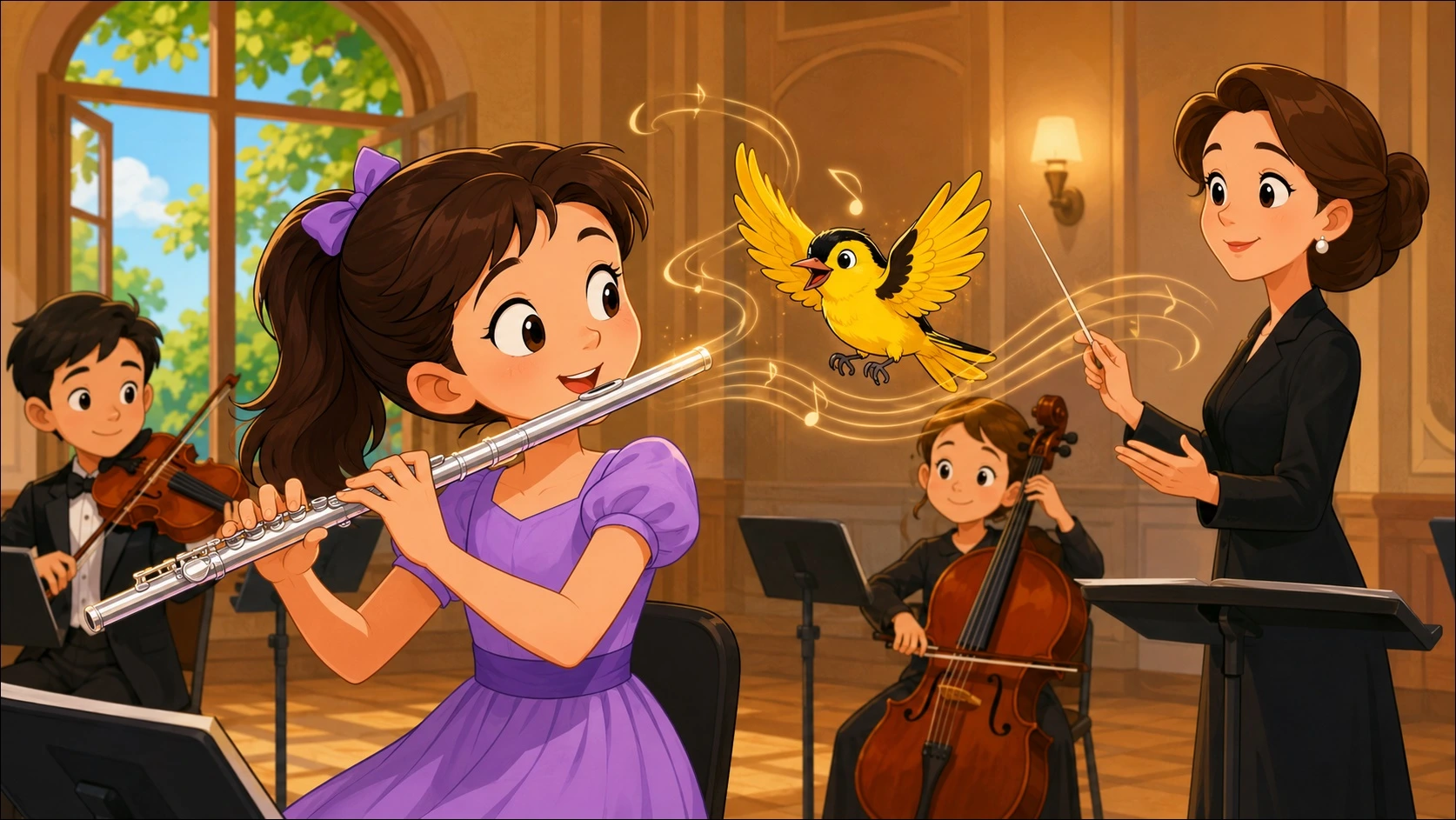
Mr Oriole and the Flute Story begins on a bright spring morning beside the old city concert hall, where tall windows opened toward a garden full of lime trees, roses, and one very curious yellow bird.
The bird’s name was Mr Oriole.
He was small, golden, quick, and proud of his beautiful song. Every morning, he perched on the highest branch of the lime tree and sang to the city before the bells began to ring.
He sang for the baker carrying warm loaves.
He sang for the children walking to school.
He sang for the sleepy cat on the garden wall, though the cat never thanked him.
Mr Oriole believed he knew every sound in the neighborhood.
He knew the rumble of carts.
He knew the splash of the fountain.
He knew the click of the concert hall doors when musicians arrived with polished cases in their hands.
But one morning, while the orchestra was rehearsing inside, Mr Oriole heard something he had never heard before.
It was not loud.
It was not heavy.
It floated.
A silver line of music slipped through the open window and curled around the lime tree like a ribbon of wind.
Mr Oriole stopped singing at once.
His head tilted left.
Then right.
The sound rose softly, bright and clear, as if a stream had learned how to laugh.
— “Who is singing inside a wooden house?”
He hopped to a lower branch.
The music came again.
Long.
Gentle.
Perfectly smooth.
Mr Oriole’s feathers fluffed with surprise.
— “That is not a robin. That is not a blackbird. That is not even a nightingale trying to show off”
He flew from the tree to the windowsill.
Inside the concert hall, the orchestra sat in a wide half-circle. Violins rested under chins. Cellos leaned against knees. A great drum waited at the back like a sleeping giant.
At the front stood the conductor, Madam Velo, with her silver hair tied in a neat knot and her baton lifted in the air.
— “From the beginning, please”
The violins began.
Soft strings trembled like morning light.
The clarinet answered.
The horn gave a warm golden call.
Then the flute entered.
Mr Oriole leaned forward so far that his tiny claws slipped on the sill.
The flautist was a young woman named Clara. She held the flute gently to her lips, and the silver instrument shone beneath the stage lamps. When she played, the whole hall seemed to breathe more quietly.
Mr Oriole’s heart beat very fast.
— “That bird is made of moonlight”
Of course, the flute was not a bird.
But Mr Oriole did not know that yet.
Clara played another phrase, light and quick. Mr Oriole answered without thinking.
Tweet-tweet-trill!
The orchestra stopped.
Madam Velo lowered her baton.
— “Who played that?”
The violinists looked at the clarinets.
The clarinets looked at the flutes.
The horn player looked inside his horn, just in case.
Mr Oriole puffed out his chest on the windowsill.
— “It was me”
Nobody understood him, because people are not very good at bird language during rehearsals.
Clara noticed the little yellow bird and smiled.
— “We have a visitor”
Madam Velo followed her gaze.
— “A very small critic”
Some of the musicians laughed softly.
Mr Oriole liked the sound of laughter, so he hopped through the window and landed on the back of an empty chair.
Madam Velo lifted one eyebrow.
— “As long as he listens politely, we continue”
They began again.
Mr Oriole tried to listen politely.
He truly did.
But when Clara’s flute sang, he felt as if someone had opened a door inside his chest.
The music called to him.
Not with words.
With brightness.
With air.
With a sound so close to flying that Mr Oriole could not stay quiet.
He answered again.
Tweet-trill-trill-tweet!
The violins stumbled.
The cellos lost their place.
The drum player, who had been counting silently, tapped the drum at the wrong moment.
Boom.
Everyone jumped.
Madam Velo closed her eyes for one calm second.
— “Again”
The orchestra tried again.
Mr Oriole tried again too.
He tried to be quiet.
He pressed his beak shut.
He held his wings tight.
He looked at the ceiling.
But Clara played one sweet, rising note, and Mr Oriole burst into song as if the note had tickled him.
Tweet-tweet-tweeeee!
The trumpet player missed his entrance.
The bassoon gave a confused honk.
The second violin dropped a pencil.
Madam Velo tapped her baton on the stand.
— “Little bird, this is rehearsal, not a forest contest”
Mr Oriole bowed proudly.
— “I accept”
Clara covered her smile with one hand.
— “I don’t think he understands”
— “Then we must help him understand”
Madam Velo pointed gently toward the window.
— “Outside, please”
Clara walked to the chair and lifted her hand. Mr Oriole hopped onto her finger without fear. Her hand was warm, and the silver flute rested against her sleeve.
Mr Oriole leaned toward it.
— “Moonlight bird”
Clara carried him to the windowsill.
— “You may listen from there”
Mr Oriole stayed on the sill.
For almost four measures.
Then he flew back inside.
By lunchtime, the orchestra was in chaos.
Mr Oriole had landed on the conductor’s music stand.
He had perched on the horn.
He had inspected the harp strings.
He had tried to sing into the open end of the bassoon and frightened himself with the echo.
But wherever he went, the moment Clara played, he flew straight to her.
He circled above her music stand.
He fluttered near the flute.
He sang every time she sang.
Clara liked him, but she could not play a concert with a yellow bird dancing around her nose.
Madam Velo called for a break.
— “This bird has excellent taste and terrible timing”
The musicians laughed again, though some sounded tired.
Clara sat by the open window with a cup of tea. Mr Oriole perched beside her and watched the flute lying across her lap.
— “Why do you follow it?”
Mr Oriole gave a soft chirp.
Clara touched the flute.
— “It is only an instrument”
Mr Oriole tilted his head.
Only?
To him, the flute did not seem like only anything.
It sounded like wind that had learned kindness.
It sounded like a bird who never ran out of breath.
It sounded like the sky had found a silver voice.
That afternoon, the orchestra tried closing the windows.
Mr Oriole pressed himself against the glass and sang outside.
They tried moving Clara farther from the window.
Mr Oriole found the side door.
They tried beginning with the loud brass section so the bird would lose interest.
Mr Oriole waited patiently through the trumpets, then flew in the instant the flute began.
Madam Velo looked at the ceiling.
— “We have been defeated by six feathers and a beak”
The concert was only three days away.
The orchestra needed to rehearse.
Clara needed to play.
Mr Oriole needed to sing.
Nobody was wrong.
But everything was tangled.
The next morning, Clara arrived early. The hall was empty except for chairs, stands, and pale sunlight on the wooden floor.
Mr Oriole was already waiting outside the window.
— “Good morning, little musician”
He chirped politely.
Clara did not open her music folder.
Instead, she lifted the flute and played one short note.
Mr Oriole answered.
She played two notes.
He copied the shape, not exactly, but beautifully.
She played a tiny rising tune.
He answered with a falling one.
Clara smiled slowly.
— “You are not interrupting because you want attention”
She played again.
Mr Oriole sang back.
— “You are answering because you think the flute is calling you”
When Madam Velo arrived, she found Clara and Mr Oriole playing a careful musical conversation across the windowsill.
Clara lowered the flute.
— “I think I know what he needs”
Madam Velo set down her baton.
— “A ticket?”
— “A part”
At first, the orchestra stared.
— “A bird part?” asked the trumpet player.
— “A listening part” Clara said. “He sings after the flute. Not over it, if we give him a place”
Madam Velo was silent.
Then she opened the score and turned several pages.
Near the end of the piece, there was a quiet passage where the flute played alone, like morning arriving over trees.
Madam Velo tapped the page.
— “Here”
The musicians leaned closer.
— “Clara plays the first phrase. The bird answers from the window. Then the orchestra enters softly underneath”
The bass player scratched his chin.
— “Can a bird follow a conductor?”
Mr Oriole stood very straight on the windowsill.
Madam Velo looked at him.
— “We shall find out”
They practiced.
At first, Mr Oriole sang too early.
Madam Velo lifted one finger.
— “Wait”
Mr Oriole hopped twice and tried again.
Then he sang too long.
Madam Velo gently lowered her hand.
— “Enough”
Mr Oriole blinked.
He was not used to anyone telling him enough.
But Clara played the phrase again, patient and clear.
This time, Mr Oriole waited until the last note floated away.
Then he answered.
Softly.
Sweetly.
Just once.
The orchestra entered beneath him, quiet as leaves.
No one moved when the passage ended.
Even the drum player held his breath.
Madam Velo lowered her baton.
— “Again”
But this time, she was smiling.
By the day of the concert, the city had heard rumors.
A bird was singing with the orchestra.
A wild bird.
A yellow bird.
A bird who liked the flute and disliked waiting, though he was improving.
Children came early and pointed at the lime tree outside the hall.
Adults whispered as they took their seats.
Mr Oriole perched on his branch, pretending not to notice how many people were watching.
Inside, Clara warmed the flute with gentle notes.
Madam Velo stepped onto the stage.
The hall became quiet.
The concert began.
The violins shimmered.
The cellos hummed.
The horns glowed.
Mr Oriole listened from the open window.
He wanted to sing at least twenty-three times.
He did not.
His claws gripped the sill.
His chest rose and fell.
He watched Madam Velo’s baton.
At last, Clara stood for the quiet flute passage.
The hall seemed to lean toward her.
She played.
The melody lifted like a bird leaving a branch.
The final note hung in the air.
Madam Velo raised one finger.
Wait.
Mr Oriole waited.
Then she gave the smallest nod.
Mr Oriole sang.
His voice was golden, bright, and alive. It was not the same as the flute, and that made it beautiful. The flute sounded like silver wind. Mr Oriole sounded like sunlight with wings.
The orchestra entered gently beneath them both.
For a moment, the concert hall and the garden became one place.
People forgot to cough.
Children forgot to whisper.
The sleepy cat on the garden wall opened both eyes.
When the piece ended, there was silence.
Then the hall burst into applause.
Mr Oriole startled and flew up to the curtain rail.
Clara laughed softly.
Madam Velo bowed to the audience.
Then, very seriously, she turned and bowed to the window.
Mr Oriole puffed out his yellow chest.
— “Naturally”
After that night, Mr Oriole did not interrupt rehearsals anymore.
Not often.
He had learned that music was not only about singing when your heart felt full.
It was also about listening for the right place to join.
Clara sometimes practiced beside the open window, and Mr Oriole would answer softly from the lime tree.
The orchestra grew used to him.
The trumpet player brought seeds.
The bassoonist built a tiny perch near the window.
Madam Velo added a small mark in her score that simply said: bird waits.
And every spring, when the lime tree bloomed and the concert hall windows opened wide, children came hoping to hear the famous golden bird who once mistook a flute for a friend and found one anyway.