Romulus and Remus
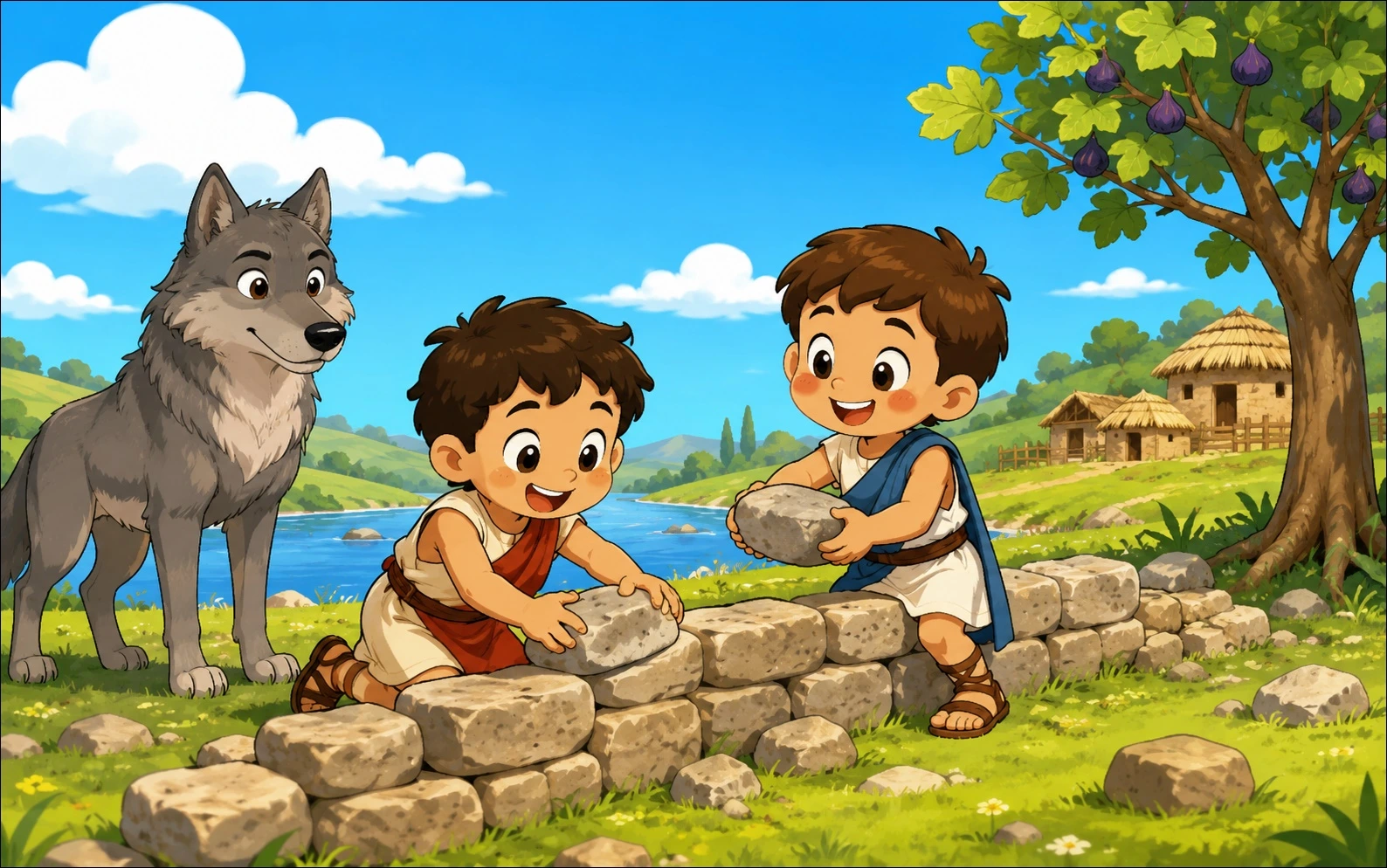
Romulus and Remus Story begins beside the River Tiber, long before Rome had streets, towers, markets, or marble temples. In those days, the hills were quiet, shepherds watched their flocks under wide skies, and the river moved through the land like a silver path.
On a stormy morning, the river was swollen from many days of rain. Brown water rushed around stones and roots. Broken branches spun in the current. Birds hid inside the trees, waiting for the clouds to pass.
Near the water, a small basket floated between the reeds.
Inside the basket were two baby brothers.
One was calm, with eyes that opened quietly at every sound.
The other kicked his tiny feet as if he was already arguing with the world.
Their names were Romulus and Remus.
The basket struck a low branch and tipped toward the muddy bank. The babies began to cry. Their voices were small, but the riverbank heard them.
So did a wolf.
She stepped from the shadow of a fig tree with careful paws. Her gray coat was wet from the rain, and her golden eyes watched the basket closely.
Most creatures would have run from a wolf.
But the babies did not know fear yet.
They only cried louder.
The wolf lowered her head.
She sniffed the basket.
Then she did something no one would have expected from a wild animal.
She gently pulled the basket away from the water.
Romulus stopped crying first.
Remus waved one tiny fist at the sky.
The wolf gave a soft huff, as if she understood that this one would be trouble.
One by one, she carried the babies to her cave beneath a rocky hill. There, among dry leaves and warm earth, she kept them safe from the wind.
Days passed.
The storm ended.
The river became calm again.
Shepherds returned to the hills with their sheep and goats. One afternoon, a shepherd named Faustulus followed strange tracks near the cave. He expected to find wolf cubs.
Instead, he found two laughing babies pulling gently at the ears of a patient she-wolf.
Faustulus froze.
— “By all the hills”
His wife, Acca, came running when he called. She looked into the cave and covered her mouth.
— “They are children”
The wolf stood between the babies and the shepherds.
She did not growl.
She only watched.
Faustulus bowed his head.
— “We will not harm them”
Acca stepped forward slowly and held out her hands. The wolf sniffed her fingers. Then, after a long silence, she moved aside.
That was how Romulus and Remus came to live in a shepherd’s hut near the hills.
They grew strong in the open air.
They learned to climb rocks before they learned to write letters.
They learned to follow hoofprints, mend fences, carry water, and share bread with travelers.
Romulus liked building things. He stacked stones into little walls and made paths between the sheep pens.
Remus liked testing things. If Romulus built a wall, Remus jumped over it. If Romulus made a gate, Remus checked whether it would swing open with one kick.
Acca often shook her head at them.
— “One of you makes the world stand still, and the other makes it run”
Romulus smiled.
— “I make it safe”
Remus grinned.
— “I make it exciting”
Faustulus would laugh and point toward the hills.
— “Then both of you had better learn when to listen”
As the boys grew older, they became known across the valley. They helped lost shepherds find their flocks. They carried food to old neighbors. When wolves came too close to the pens, Romulus stood firm with a torch while Remus shouted so loudly that even the owls woke up.
The brothers were different, but they were strongest together.
One evening, after a long day in the hills, Faustulus sat with them beside the fire. The sky outside was purple, and the first stars were appearing above the dark line of trees.
He looked at the two young men and sighed.
— “There is something you must know”
Romulus lowered the wooden bowl in his hands.
Remus leaned forward.
— “Is it about the wolf?”
Faustulus nodded.
— “And about the river”
Acca took Romulus’s hand, then Remus’s.
— “We raised you with all our love, but we did not find you as ordinary children are found”
Faustulus told them about the storm, the basket, the cave, and the wolf who had guarded them as if they were her own cubs.
For a while, neither brother spoke.
Romulus looked into the fire.
Remus looked toward the dark hills.
— “Who were our parents?”
Faustulus took a slow breath.
— “That is the part I feared telling you”
He explained that they had been born into a royal family of Alba Longa, an old city beyond the hills. Their grandfather Numitor had once been king, but his jealous brother had taken the throne by force. The babies had been hidden away because the false king feared what they might become.
Remus stood at once.
— “Then our grandfather is still there?”
— “If he lives”
Romulus rose more slowly.
His face was calm, but his eyes had changed.
— “Then we go to Alba Longa”
Acca held his hand tighter.
— “Not for revenge”
Romulus looked at her.
— “For truth”
Remus picked up his cloak.
— “And maybe a little thunder”
The next morning, the brothers set out with Faustulus and several loyal shepherds. They crossed the hills, followed dusty roads, and reached Alba Longa by sunset.
The city was not as bright as they had imagined.
Its gates were heavy.
Its people spoke softly.
Its palace windows seemed to watch everyone below.
In the market, Romulus and Remus heard whispers about the false king.
He took more grain than families could spare.
He punished honest speech.
He trusted no one because he had earned no trust.
That night, the brothers found their grandfather Numitor living quietly under guard in an old house near the palace garden. His hair was white now, but when he saw them, his hands trembled.
— “Those eyes”
He stepped closer.
— “You look like my daughter”
Romulus bowed his head.
— “We were told you might know who we are”
Numitor touched both their faces as if he was afraid they would vanish.
— “My grandsons”
Remus swallowed hard.
— “Then we came home”
— “No”
Numitor looked toward the palace.
— “You came to wake it”
The next day, Romulus and Remus stood in the city square. They did not arrive with gold, armies, or royal banners. They arrived with shepherds, farmers, bakers, and people who had grown tired of whispering.
Romulus spoke first.
— “A crown does not make a king honest”
Remus stepped beside him.
— “And fear does not make a city loyal”
The people listened.
The false king sent guards to silence them, but the crowd would not move aside. The truth spread from one street to another. By evening, the palace gates opened, and Numitor was restored to his rightful place.
Alba Longa celebrated for three days.
There was music in the square, bread on every table, and lamps shining in windows that had stayed dark for years.
Numitor offered the brothers fine rooms in the palace.
Romulus thanked him.
Remus admired the pillows.
But neither brother slept well under a roof of carved stone.
On the fourth morning, they walked together beyond the city walls.
The hills rose before them, green and open.
The River Tiber shone in the distance.
Romulus stopped on a high slope and looked across the land.
— “There should be a city here”
Remus turned to him.
— “Here?”
— “A new one”
Romulus’s voice grew bright.
— “A city for shepherds and travelers, farmers and craftsmen, people who need strong walls but also fair laws”
Remus looked toward another hill nearby.
It was broad, sunlit, and open to the wind.
— “That hill is better”
Romulus shook his head.
— “This one has the stronger view”
— “Mine has more space”
— “Mine is easier to defend”
— “Mine feels freer”
Their voices rose.
For the first time since learning who they were, the brothers stood apart.
Faustulus, who had followed them quietly, placed his shepherd’s staff between them.
— “A city cannot begin with two brothers shouting louder than they listen”
Romulus looked away.
Remus kicked a stone down the path.
That evening, they agreed to watch the sky for a sign. Each brother would stand on his chosen hill at dawn. If the birds favored one hill, they would build there.
Before sunrise, Romulus climbed the Palatine Hill.
Remus climbed the Aventine.
The sky slowly turned from black to violet to gold.
Romulus waited.
Remus waited.
Then birds appeared.
Remus saw six great birds rise above the trees.
He shouted with joy.
Across the valley, Romulus saw twelve birds circle high in the morning light.
His followers cheered.
Both brothers believed the sign was theirs.
The argument returned, sharper than before.
Remus crossed to Romulus’s hill and looked at the first stones being placed for the wall.
— “So this is your great city?”
Romulus folded his arms.
— “It will be”
Remus stepped over the low line of stones.
— “A fox could jump this wall”
Romulus’s face hardened.
— “Do not mock what is only beginning”
Remus stopped.
For a moment, the brothers looked at each other and saw not enemies, but the boys they had been: two children from the river, two shepherds from the hills, two brothers raised under the same roof.
Remus lowered his voice.
— “Then let it begin with both of us”
Romulus looked at the stones.
He looked at the open land.
He looked at his brother.
Slowly, he lifted one of the stones and placed it back in the line.
— “Then help me build it stronger”
Remus picked up another stone.
— “And wider”
— “And fairer”
— “And with a gate big enough for people who arrive with nothing”
Romulus smiled.
— “Especially them”
So the brothers built.
Not alone.
Shepherds came first, bringing timber and goatskin water bags.
Farmers arrived with oxen and carts.
Stonecutters came from nearby villages.
Mothers carried bread.
Children carried small stones and felt very important doing it.
Romulus planned the walls.
Remus planned the gates.
Romulus marked places for watchtowers.
Remus chose places where markets could grow.
They still argued.
Often.
But now they argued over how to make the city better, not over who mattered more.
One evening, when the first wall stood high enough to cast a shadow, the she-wolf appeared on the hill.
She was older now.
Her muzzle had silver in it.
She stood quietly above the workers and watched the city rising from the earth.
Romulus saw her first.
Remus followed his gaze.
Neither brother moved.
The wolf looked at them for a long moment, then turned toward the river.
— “She remembers”
Remus spoke softly.
Romulus nodded.
— “So will we”
When the city was finally named, the people gathered at sunrise. The walls were still new. The streets were still dust. The houses were simple, and the market was only a wide open space.
But hope lived there already.
Romulus stood before the people with Remus at his side.
— “This city was not born from gold”
He looked toward the river.
— “It began with a basket, a storm, and a mercy no one expected”
Remus stepped forward.
— “Let its gates stay open to the brave, the lost, the hardworking, and the honest”
The people cheered.
They called the city Rome.
Years passed, and Rome grew.
Its paths became streets.
Its stones became walls.
Its markets filled with voices from many lands.
At the heart of the city, the people kept a small place sacred: a cave beneath a hill, where the story said a wolf had once guarded two helpless children.
Children visited it with their parents.
They asked whether the wolf had truly been real.
The elders would smile and say that some stories are larger than proof.
Romulus and Remus grew older too.
They remained different.
Romulus still loved strong walls.
Remus still loved open gates.
But whenever the city faced a hard choice, the brothers walked together to the hill above the river.
There, with the wind moving through the grass, they remembered what the Tiber had taught them.
A life can begin in danger and still grow into greatness.
A home can be made by those who were once lost.
And a city is strongest when the people inside it remember to protect one another.
Long after the brothers were gone, Rome still stood under the Italian sun.
Its people told the story again and again: of two babies, a river, a wolf, two hills, and a dream built from stone, courage, and brotherhood.