The Ugly Duckling
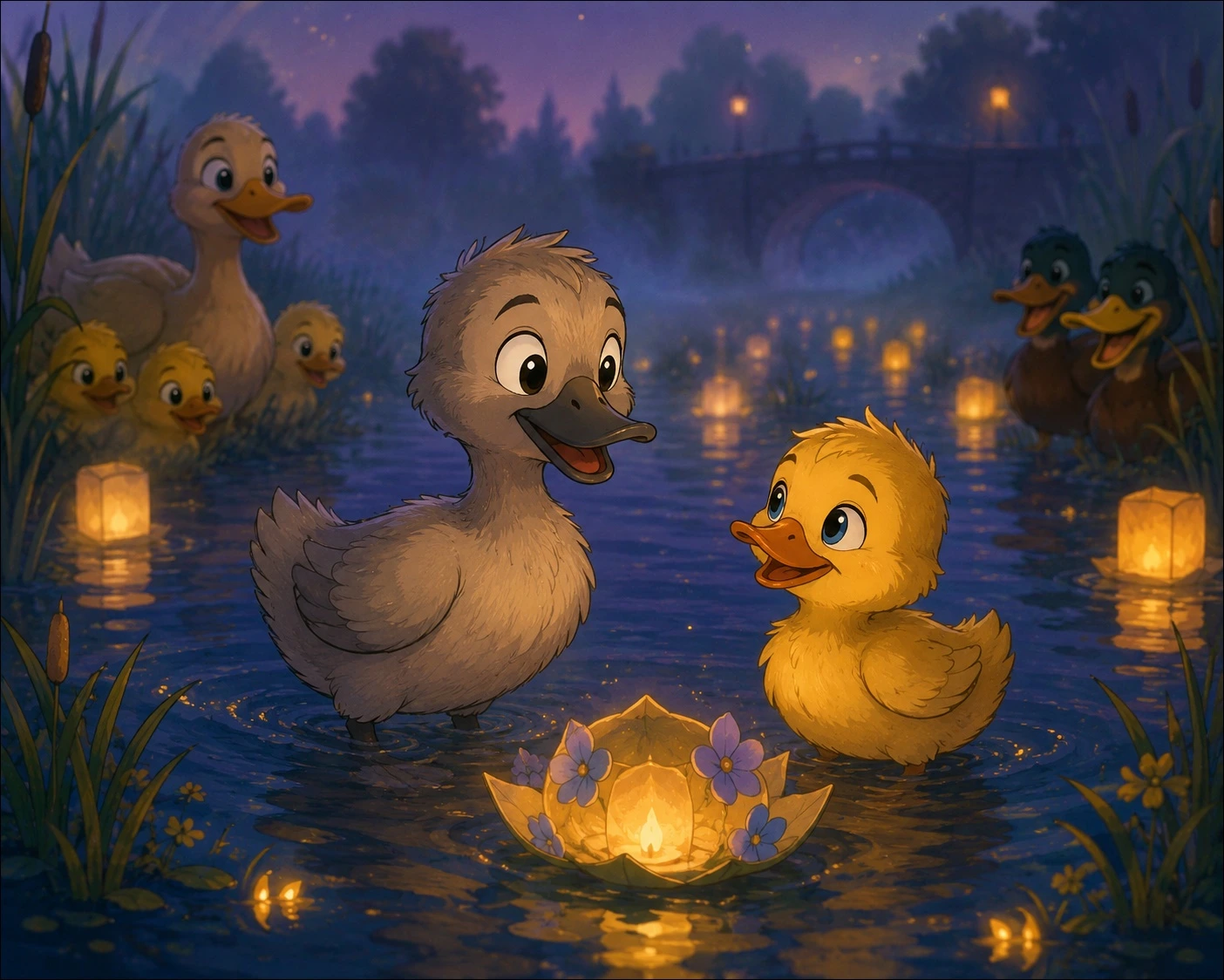
Spring arrived late at Reedglass Marsh. For weeks, cold rain tapped against the willow roots, and the ponds remained the color of cloudy glass. Then, one warm morning, the reeds lifted their green heads and Mother Tansy heard the first crack beneath her wings.
Five small eggs opened quickly. Out tumbled five yellow ducklings with round bodies, bright beaks, and voices that filled the nest.
— “The pond is waiting for us!”
— “I want to swim first!”
— “I want breakfast first!”
One egg remained. It was larger than the others and pale green instead of cream. Mother Tansy waited through the morning, through lunchtime, and almost until sunset.
At last, the shell split.
A long gray head appeared, followed by a narrow body, wide feet, and two wings that seemed to have been borrowed from a much larger bird.
The new duckling blinked at the crowded nest.
— “Is there room for me?”
Mother Tansy moved aside at once.
— “There is always room.”
She named him Orin.
Orin tried to sit like the other ducklings, but his legs folded in the wrong places. When he stood, his head rose above everyone else. His feathers were not soft yellow. They were gray and uneven, with darker patches around his shoulders.
His sister Pip studied him carefully.
— “You look like a rain cloud with feet.”
Orin looked down at himself.
— “Is that bad?”
Pip considered the question.
— “Rain clouds are useful.”
The family left the nest the next morning. Mother Tansy led them to the shallow pond, where the water was warm near the bank and minnows flashed beneath the surface.
The yellow ducklings jumped in with neat little splashes.
Orin stepped onto a wet stone, slipped, and landed chest first in the pond.
A group of young drakes nearby burst into laughter.
— “Look at those enormous feet!”
— “What kind of duckling has a neck like that?”
— “An ugly one.”
The word followed Orin across the water.
He pretended not to hear it, but his chest tightened. He tried to paddle like his brothers and sisters. His broad feet pushed him forward so quickly that he passed them all and crashed into a floating patch of duckweed.
The drakes laughed again.
After that day, Orin began checking his reflection whenever the water was still. He tucked his neck down. He pressed his wings close to his body. He tried to make his feet look smaller by standing in mud.
Nothing worked.
At the marsh school, the young birds practiced dipping, diving, and calling to one another across the reeds.
Every duckling had a clear quack.
Orin opened his beak.
A low, musical note floated over the pond.
The teacher tilted her head.
— “Try again.”
Orin did.
The same strange call came out, softer than a honk and deeper than a whistle.
The class giggled.
Orin stopped trying.
Only Pip stayed beside him after the lesson.
— “I like your call.”
— “It does not sound right.”
— “It sounds like you.”
Orin wanted that to be enough. Some days, it almost was.
As summer grew warmer, Reedglass Marsh prepared for the Lantern Float. Once each year, every bird family made a small lantern from reeds, flower petals, and firefly glass. At dusk, the lanterns were set upon the water and allowed to drift toward the old stone bridge.
Orin loved the festival. He was especially good at weaving reeds because his long beak could reach through tight loops.
He made a lantern shaped like a silver leaf. Pip decorated it with blue petals.
On the evening of the Lantern Float, the marsh glowed with hundreds of tiny lights. Music drifted from the bank. Frogs kept rhythm on hollow logs while crickets chirped between the songs.
Mother Tansy placed the family lantern on the water.
— “Stay close to the bank.”
The ducklings promised they would.
For a while, everything went perfectly. Orin and Pip followed their lantern as it moved through the reeds. Their brothers and sisters chased reflections nearby.
Then the wind changed.
A white fog rolled over the water so quickly that the bridge vanished. The lanterns became blurred dots, then disappeared completely.
Birds called from every direction.
— “Back to the bank!”
— “Follow the bells!”
— “Keep your families together!”
Mother Tansy gathered three ducklings beside her.
Pip and Orin were on the other side of the reed bed.
— “Mama!”
Pip’s call faded into the fog.
Orin tried to answer with a quack, but fear closed his throat. He could not see the bank. Every channel looked the same.
Pip pressed close to him.
— “Which way do we go?”
Orin listened.
He heard frogs, splashing wings, and the distant festival bell. The sounds bounced from the reeds and seemed to come from everywhere.
Underneath them was another sound.
It was a deep humming note, steady and low.
Orin lifted his head.
— “The current is moving beneath us.”
— “I cannot hear it.”
— “I can.”
He stretched his long neck above the fog. Far away, the top of the old willow tree rose like a dark hand. The family nest stood beyond it.
For the first time, Orin did not wish to be shorter.
— “Stay behind me.”
His wide feet pushed strongly against the hidden current. Pip followed his wake.
They had crossed half the channel when a frightened cry came from the reeds.
Two younger ducklings from another nest were trapped among broken stems. One had a strand of festival ribbon twisted around his leg.
Pip looked toward the distant bank.
— “We need to find Mama.”
Orin looked at the trapped ducklings.
He was frightened too. He wanted to reach home. He wanted someone larger to solve the problem.
No one larger was there.
— “We cannot leave them.”
Orin pushed into the reeds. The stems scratched his wings, but his long neck allowed him to reach the knotted ribbon. He pulled once. The knot tightened.
He took a slow breath and worked the ribbon loose with the tip of his beak.
The duckling kicked free.
— “Can you swim?”
— “Yes, but we do not know the way.”
— “Follow my voice.”
Orin made the strange call he had hidden at school.
The low note traveled cleanly through the fog.
Pip answered.
The rescued ducklings answered too.
Orin called again, and the little group moved after the sound.
Along the way, more lost birds heard him. A moorhen chick joined them. Then three young grebes. Even an elderly coot, who had become turned around near the lilies, followed Orin’s steady call.
The group grew until twelve birds moved behind him in a careful line.
At the bank, Mother Tansy heard the note.
She stopped calling and listened.
— “That is Orin.”
The other adults became quiet.
Across the fog came the low call again.
Mother Tansy answered with all the strength in her voice.
Orin changed direction toward her call. A few moments later, his gray head appeared through the mist. Pip followed, then the lost ducklings, the grebes, the moorhen, and the tired old coot.
The bank erupted in relieved cries.
Mother Tansy wrapped both wings around Orin and Pip.
— “You brought them home.”
Orin looked at his broad feet, his long neck, and the gray wings he had spent all summer trying to hide.
— “The things that looked wrong helped me.”
— “Perhaps they were never wrong.”
The fog lifted before midnight. Most lanterns had drifted away, but Orin’s silver leaf lantern was found near the old stone bridge, still glowing.
After the festival, the marsh birds treated Orin differently. Some praised him. Some apologized. The young drakes who had mocked him no longer laughed when he passed.
Orin appreciated the change, but he did not suddenly forget every unkind word. Confidence returned slowly. He began using his call at school. He stopped folding his neck whenever someone looked at him.
Autumn painted the reeds gold.
One afternoon, two great white birds landed on the pond. They had long necks, black feet, and wings that spread wider than the path beside the water.
Orin stared at them.
They stared back.
One of the visitors swam closer.
— “We heard a young swan guided birds through the Lantern Fog.”
Orin glanced behind him.
— “There are no swans here.”
The visitor smiled.
— “There is one.”
Mother Tansy came to stand beside Orin. She looked at the white birds, then at the pale green shell she had kept near the nest all summer.
The truth became clear.
The spring flood must have carried Orin’s egg from a swan nest upriver and left it among her own.
Orin felt as if the pond had shifted beneath him.
— “So I am not a duck?”
— “You are a young swan.”
Orin turned to Mother Tansy.
— “Does that mean you are not my family?”
Mother Tansy touched her beak to his forehead.
— “It means our family began in an unexpected way.”
Pip squeezed beneath his wing.
— “You are still my brother.”
The swans stayed for several days. They taught Orin how to lift his wings into the wind and how to recognize the long calls of swans traveling high above the clouds.
They invited him to fly south with them before winter.
Orin was nervous, but he was no longer ashamed of being nervous.
On the morning of departure, the entire duck family gathered by the water.
— “Will you come back?”
— “As soon as the reeds turn green.”
Orin ran across the pond. His wide feet struck the surface. His large wings opened, caught the wind, and carried him into the sky.
For a moment, he wobbled.
Then he rose.
Winter passed.
When spring returned to Reedglass Marsh, a white swan descended through the morning mist. His feathers shone in the early light, but his low, musical call was the same.
Pip raced into the pond.
— “Orin!”
He folded his wings and met her near the bank.
The young drakes watched in amazement. Orin saw his reflection in the water, but he did not study it to decide whether he was worthy of being there.
He already knew.
That summer, Orin became the marsh guide. Whenever fog covered the channels, he raised his long neck above the mist and called until every lost traveler found the bank.
Some birds remembered him as the awkward gray duckling.
Pip remembered the brother who had always listened for others.
And Orin remembered something more important than either name.
He had belonged before his feathers changed.