Nori and the Bridge of Brave Promises
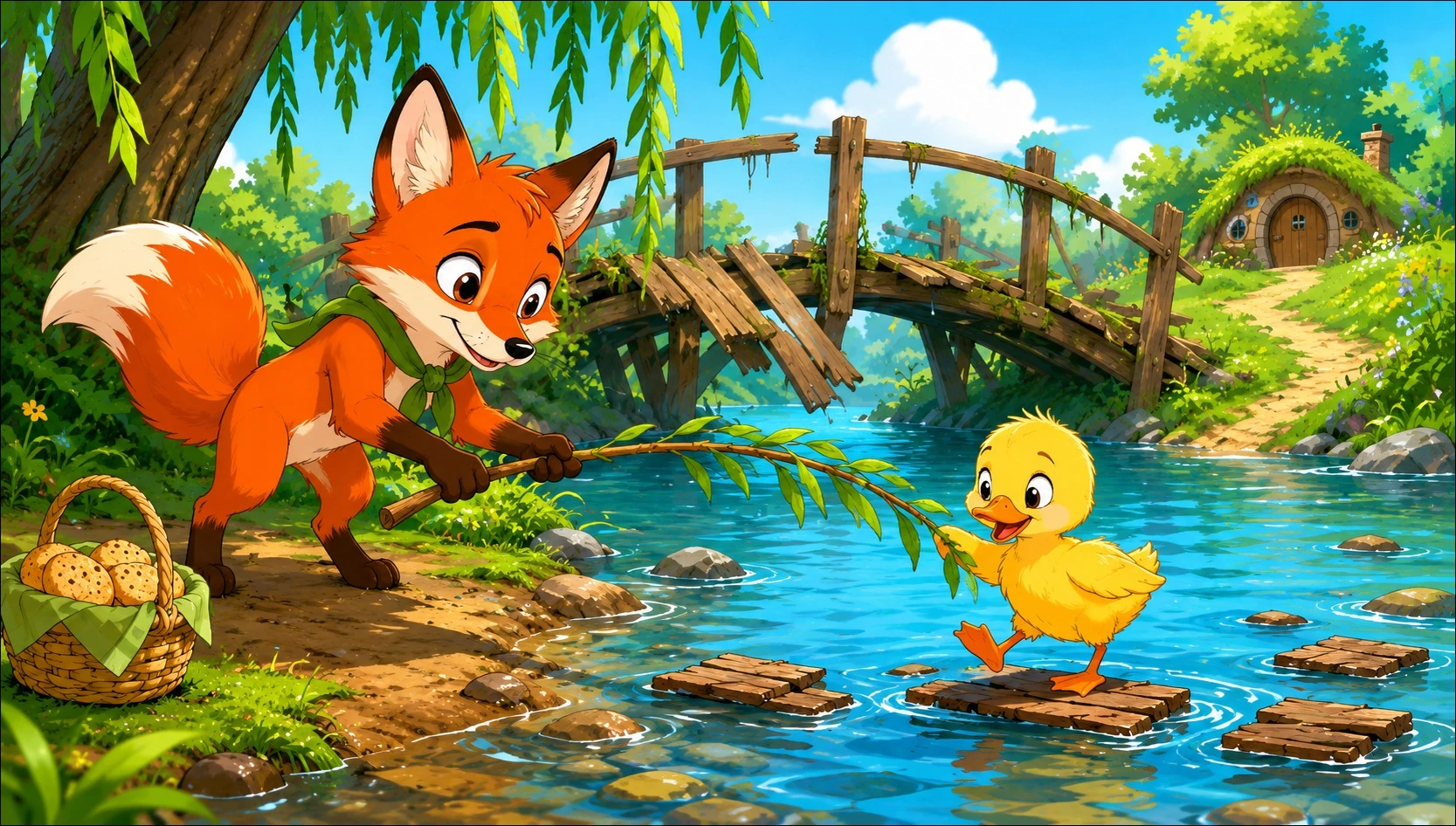
Nori was a young fox with copper-red fur, quick feet, and ears that heard almost everything.
He lived near Willowbend Woods, where the trees leaned over a small river and the wind carried the smell of mint, moss, and wild apples.
Nori liked running.
He liked winning races against falling leaves.
He liked jumping over roots before his shadow could catch him.
But there was one thing Nori did not like.
Waiting.
Waiting made his paws itch. Waiting made his tail twitch. Waiting felt like standing still while the whole world was having an adventure without him.
One morning, Nori’s mother asked him to carry a small basket of warm oat cakes to Elder Mole, who lived beyond the old wooden bridge.
— Go carefully, said Mother Fox. The rain was heavy last night. The river may be high.
Nori lifted his nose proudly.
— I am fast, Mother. I will be there before the steam leaves the cakes.
Mother Fox placed one paw gently on his shoulder.
— Fast is useful, she said. Faithful is better.
Nori blinked.
— What does faithful mean?
— It means your promise can trust you, even when the road changes.
Nori did not fully understand, but he liked the sound of it. A promise that could trust him sounded important.
So he took the basket in his mouth and trotted into Willowbend Woods.
The morning was bright after the storm. Sunlight shone on wet leaves. Drops of water hung from the branches like tiny glass bells. The path smelled fresh and clean.
Nori moved quickly at first.
He leaped over a puddle.
He slid beneath a low branch.
He passed a family of beetles carrying crumbs in a neat line.
— Morning! called Nori through the basket handle.
The beetles waved their antennae and kept working.
Near the blackberry bushes, Nori met Tessa the squirrel. She was sitting on a stump, polishing an acorn with a leaf.
— Where are you going so proudly? asked Tessa.
— To Elder Mole’s house, said Nori. I made a promise.
— Promises are easy, said Tessa. You say them, then you run.
Nori smiled. That sounded exactly right to him.
But then a voice came from the grass.
— Promises are not only words.
Nori looked down and saw a small field mouse with gray whiskers and a serious face.
— What are they, then? asked Nori.
— They are little bridges, said the mouse. You build them with words, but you keep them standing with what you do next.
Tessa rolled her eyes.
— Mice make everything sound like homework.
Nori laughed and ran on, but the mouse’s words followed him.
Little bridges.
He wondered if his promise had a bridge inside it.
Soon he heard the river.
Usually, the Willowbend River whispered over stones. Today it talked loudly. It rushed and slapped against the banks, brown from the rain and full of floating twigs.
Nori reached the old wooden bridge and stopped.
One plank had broken.
Another plank leaned sideways.
The middle of the bridge sagged toward the water like a tired smile.
Nori’s ears flattened.
— Oh.
He looked at the basket. The oat cakes still smelled warm.
He looked at the bridge. It did not look warm at all.
Nori took one step forward.
The bridge creaked.
He stepped back at once.
His paws wanted to run across before fear could catch him. His pride wanted to say, “I am quick enough.”
But Mother Fox’s words returned.
Faithful is better.
Nori sat down on the muddy bank and forced his tail to be still.
— A promise can trust me, he whispered. So I must not do something foolish with it.
He searched the riverbank.
To the left, the bank was steep and slippery.
To the right, the reeds grew thick near a bend in the river.
Across the water, he could see Elder Mole’s hill. Smoke rose gently from the chimney hole. Elder Mole was home.
Nori walked along the bank, slowly now. The mud grabbed at his paws. The basket bumped against his chest.
At the bend, he heard a tiny, unhappy sound.
— Peep! Peep!
Nori froze.
The sound came again.
— Peep! I am stuck!
Under a curtain of wet reeds, a young duckling sat on a flat stone. The water swirled around the stone, and the duckling’s yellow feathers were damp and ruffled.
Nori placed the basket carefully on dry moss.
— How did you get there? he asked.
The duckling sniffed.
— I followed a shiny beetle. Then the river became too loud. Now I cannot get back.
— Where is your family?
— Past the willow roots. I can hear them, but they cannot hear me.
Nori looked toward Elder Mole’s hill.
Then he looked at the duckling.
The oat cakes were his promise.
The duckling was a need right in front of him.
Nori’s stomach tightened.
— I promised to deliver these cakes, he said quietly.
The duckling’s eyes grew round.
— Then you should go.
Nori did not move.
A promise was not supposed to make him ignore someone small and frightened. But helping did not mean jumping into a dangerous river, either.
He remembered the field mouse.
Promises are little bridges.
Maybe he had to build one.
Nori looked around again, this time more carefully.
There was a fallen willow branch caught between two roots. It was long, flexible, and covered in leaves. Near it lay several flat pieces of bark, loosened by the storm.
Nori dragged the willow branch toward the water. It was heavier than it looked.
He pulled.
He pushed.
He slipped once and landed nose-first in the mud.
The duckling blinked.
— Are you all right?
Nori lifted his muddy face.
— I meant to do that.
The duckling stared.
— You meant to put mud on your nose?
Nori sighed.
— No.
The duckling gave a tiny laugh. It was a soft sound, but it made the river feel less frightening.
Nori laid the willow branch from the bank toward the stone. It did not reach all the way, but it reached close enough for the duckling to hold with her beak.
Then he pushed the flat bark pieces into the shallow edge, making a small stepping path where the water was calmer.
— Listen carefully, said Nori. Do not hurry. Put one foot on the bark. Hold the branch. If the water pushes, stop and wait.
The duckling trembled.
— What if I fall?
— Then I am here, said Nori.
He said it simply. Not proudly. Not loudly.
And because he said it that way, the duckling believed him.
She stepped from the stone onto the first piece of bark.
The bark tipped.
— Stop, said Nori.
She stopped.
The water moved around her feet.
— Now the next one.
She moved again.
Slowly, with the willow branch between them, the duckling crossed the shallow water.
When she reached the bank, she ran straight into Nori’s front legs.
— You stayed!
— I said I would, said Nori.
— Is that a promise?
— It became one when you needed it.
Nori picked up the basket again, and together they followed the river toward the willow roots.
After a short walk, they heard worried quacking.
— Lila! Lila!
The duckling flapped her tiny wings.
— That is my mother!
Mother Duck burst from the reeds with four ducklings behind her.
Lila rushed forward, and Mother Duck gathered her close with a sound that was half laugh, half cry.
— Where were you? asked Mother Duck.
— On a stone, said Lila. Then Nori built a bridge that was not really a bridge, but it worked like one.
Mother Duck turned to Nori.
— Thank you, young fox.
Nori lowered his head.
— I still have to bring oat cakes to Elder Mole.
Mother Duck looked at the broken bridge in the distance.
— The bridge is unsafe today. But there is another crossing near the old stones. It is longer, but the water is slow there.
Nori’s ears lifted.
— Can you show me?
— Of course, said Mother Duck. A good turn should not leave another promise lost.
So Mother Duck led Nori along the riverbank.
It was not a quick path.
They walked around brambles.
They climbed over roots.
They stopped twice while Lila explained, in great detail, how brave she had been while sitting very still.
Nori listened, even though his legs were tired and the oat cakes were no longer steaming.
At last they reached the old stones. They sat in the shallow water like gray turtles, wide and steady.
Nori tested the first stone with one paw.
It held.
He crossed slowly, basket held high.
On the far side, Elder Mole’s hill was close.
Nori thanked Mother Duck and hurried the final part of the way, though not too hurriedly. He had learned something about that.
Elder Mole opened his round wooden door before Nori could knock.
— I wondered if you might turn back, said Elder Mole.
Nori placed the basket inside.
— The bridge was broken. Then a duckling was stuck. Then I had to find the old stones.
Elder Mole opened the cloth over the basket. The oat cakes were no longer hot, but they were still soft.
— Your mother sent food, said Elder Mole. You brought a story with it. That is a fine delivery.
Nori sat down, tired from his nose to his tail.
— I wanted to be fast.
— And were you?
— No.
— Were you faithful?
Nori thought of the broken bridge, the scared duckling, the willow branch, the longer path, and the basket that had still arrived.
— I think so, he said.
Elder Mole poured warm nettle tea into two little cups.
— Many young animals think loyalty means never changing direction, he said. But sometimes the loyal path bends. What matters is that your heart does not run away from what is right.
Nori wrapped his tail around his paws.
— So loyalty can be slow?
— Often.
— Muddy?
— Very often.
— And late?
— Sometimes. But late with care is better than early with carelessness.
Nori smiled. That answer felt solid, like one of the old stones in the river.
When he returned home in the evening, the sky was pink and gold. Mother Fox was waiting near the burrow.
She saw the mud on his legs, the tiredness in his walk, and the careful way he carried the empty basket.
— You were gone a long time, she said.
— The bridge was broken, said Nori. I helped a duckling. I found another crossing. The cakes arrived, but not fast.
Mother Fox touched her nose to his forehead.
— Then your promise had a hard road, and you walked it well.
Nori looked back toward the trees. The river was hidden now, but he could still hear it moving in the distance.
— I thought loyalty meant doing exactly what I said I would do, he said. But today it felt bigger than that.
— What did it feel like? asked Mother Fox.
Nori thought carefully.
— It felt like not dropping one promise just because another creature needed help. It felt like finding a safer way instead of showing off. It felt like staying kind when the road became different.
Mother Fox smiled.
— That is loyalty.
That night, Nori curled into his warm bed of leaves.
His paws ached.
His tail was still damp.
There was a little bit of mud behind one ear that nobody had noticed yet.
But inside, Nori felt peaceful.
He had not been the fastest fox in Willowbend Woods that day.
He had not crossed the broken bridge.
He had not arrived before the steam left the oat cakes.
Still, he had kept his promise.
He had helped someone smaller than himself.
He had chosen the safe way when the proud way called louder.
And before sleep covered him like a soft blanket, Nori understood what his mother had meant.
Loyalty is not only staying on the path you planned.
It is keeping your heart steady when the path changes.
It is the quiet courage to help, the patience to think, and the promise to come back with everyone safe.
And sometimes, loyalty looks like a young fox, a muddy riverbank, and a little bridge made from a willow branch.